Buying Property in Cyprus: The Big Problems Nobody Warns You About
Title deeds that take years to arrive, mortgages hiding on the land, access roads that only exist on paper. The five problems that catch foreign buyers — and the due diligence that stops every one of them.
AD
Adam Dankhazi
Founder & Chief Remote Pilot
Ask anyone who has bought — or tried to buy — property in Cyprus, and the same big problems come up again and again: title deeds that take years to arrive, developer mortgages hiding on the land, planning and boundary surprises, the legal minefield of the north–south divide, and the risks of buying sight-unseen from another country. Here is the part nobody says loudly enough: every one of them is avoidable with due diligence done before you sign. Most buyers only discover that afterwards.
We fly drones over Cyprus land for a living — plots, building sites, half-finished developments — and much of that work is commissioned by overseas buyers who want to see exactly what they are paying for before any money moves. Buyers ask us to fly a parcel before they commit precisely because the thing you cannot verify from another country is the thing that catches people out. This guide walks through the five problems we hear about most, how to spot each one early, and who to hire so none of them becomes yours.
Is it wise to buy property in Cyprus?
Yes — with your eyes open. The Republic of Cyprus is an EU member state with a functioning Land Registry, a legal system familiar to anyone from a common-law country, and prices that still look reasonable next to most of the UK. Thousands of foreign buyers complete purchases here every year without drama and end up with exactly the life in the sun they were after.
But Cyprus also has a well-earned reputation for punishing buyers who skip their homework. The title-deed backlog is a well-documented, decades-old issue, and while consumer protections have improved, enforcement can be slow. The pattern is remarkably consistent: buyers who hire an independent lawyer and verify the land before signing tend to be fine; buyers who treat the purchase like an extended holiday booking end up in the horror stories.
Problem 1: Title deeds — the classic Cyprus trap
This is the problem Cyprus is famous for. You pay for a property in full, you move in, you live there for years — and the title deed is still not in your name. Historically this happened because a developer could not transfer individual deeds until the whole development was completed and certified, and until the developer's own obligations to the state and its banks were settled. Some buyers waited decades. Some are still waiting.
Living without a deed is not a paperwork inconvenience. Until the title is registered in your name, you cannot easily sell or remortgage, and you are exposed to whatever happens to the person or company whose name is on the deed. Legislation aimed at so-called trapped buyers has improved the picture, but it has not eliminated the problem.
How to avoid it: before you commit, have your lawyer confirm at the District Land Office whether a separate title deed exists for the specific property. If you are buying off-plan or from a developer, insist your contract of sale is deposited at the Land Registry — this protects your right to eventually claim the title (known as specific performance). And if a seller waves the deed question away with "it's coming, everyone here is waiting", treat that as your cue to slow down.
Problem 2: Hidden developer mortgages and memos on the land
The second trap sits underneath the first. In many of the worst cases, buyers discovered — years after paying in full — that the developer had mortgaged the land their home stood on to fund the wider project. When the developer later hit financial trouble, the bank's claim ranked ahead of the buyers who lived there. People who had paid every cent they owed found a bank holding their home as someone else's collateral.
Mortgages are not the only encumbrance to check for. Memos — court judgments registered against the land — plus unpaid taxes and other charges can all sit on a property invisibly. None of them appear in the sales brochure, and all of them appear in one document: a Land Search Certificate from the Department of Lands and Surveys.
How to avoid it: have your lawyer obtain a fresh land search before you sign anything, and again immediately before completion. If a developer mortgage exists, do not accept verbal reassurance — your lawyer should require a bank waiver releasing your specific property from the security, or structure the deal so funds clear the encumbrance at transfer.
Problem 3: Planning, boundaries and "what exactly am I buying?"
This one catches land buyers more than home buyers, and it is the problem we see from the air every week. Plots in Cyprus are often sold from old survey plans, off-plan drawings or a pin on a map. On paper, everything looks tidy. On the ground: boundaries nobody has marked out, a neighbour's fence sitting metres inside the plot, a "road" on the plan that is a dirt track — or does not exist at all — and building zones that will not support the villa you were picturing.
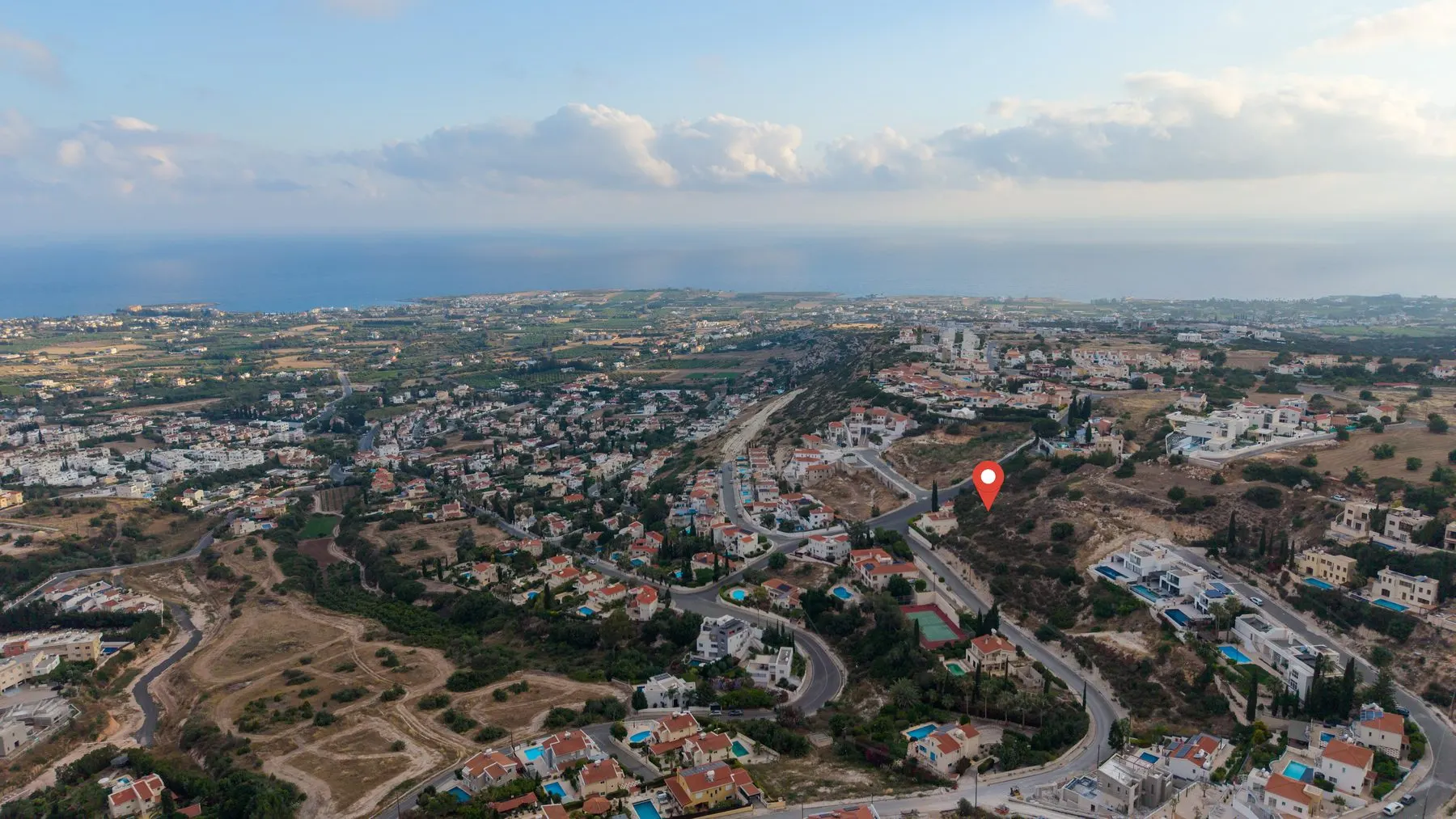
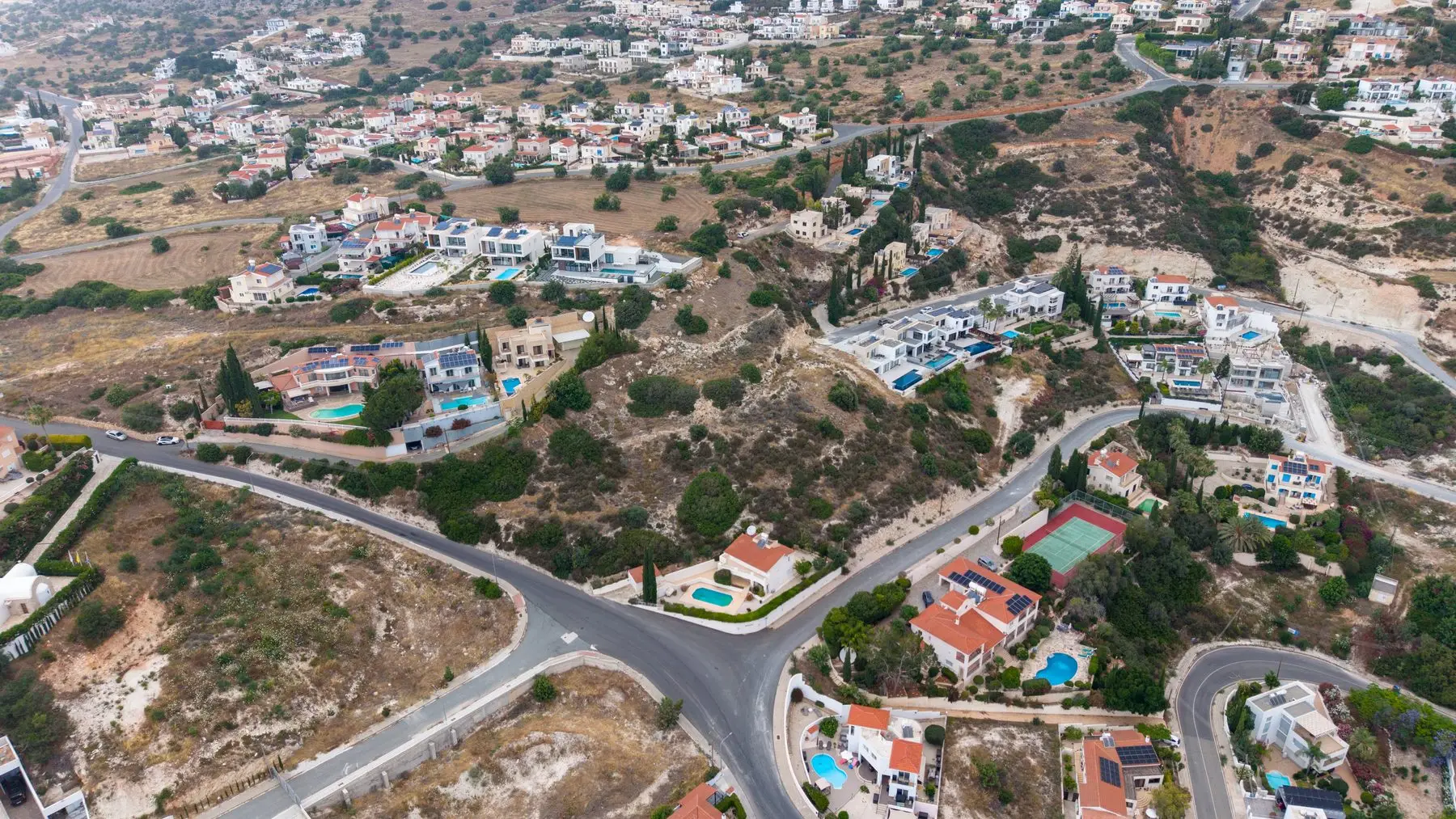
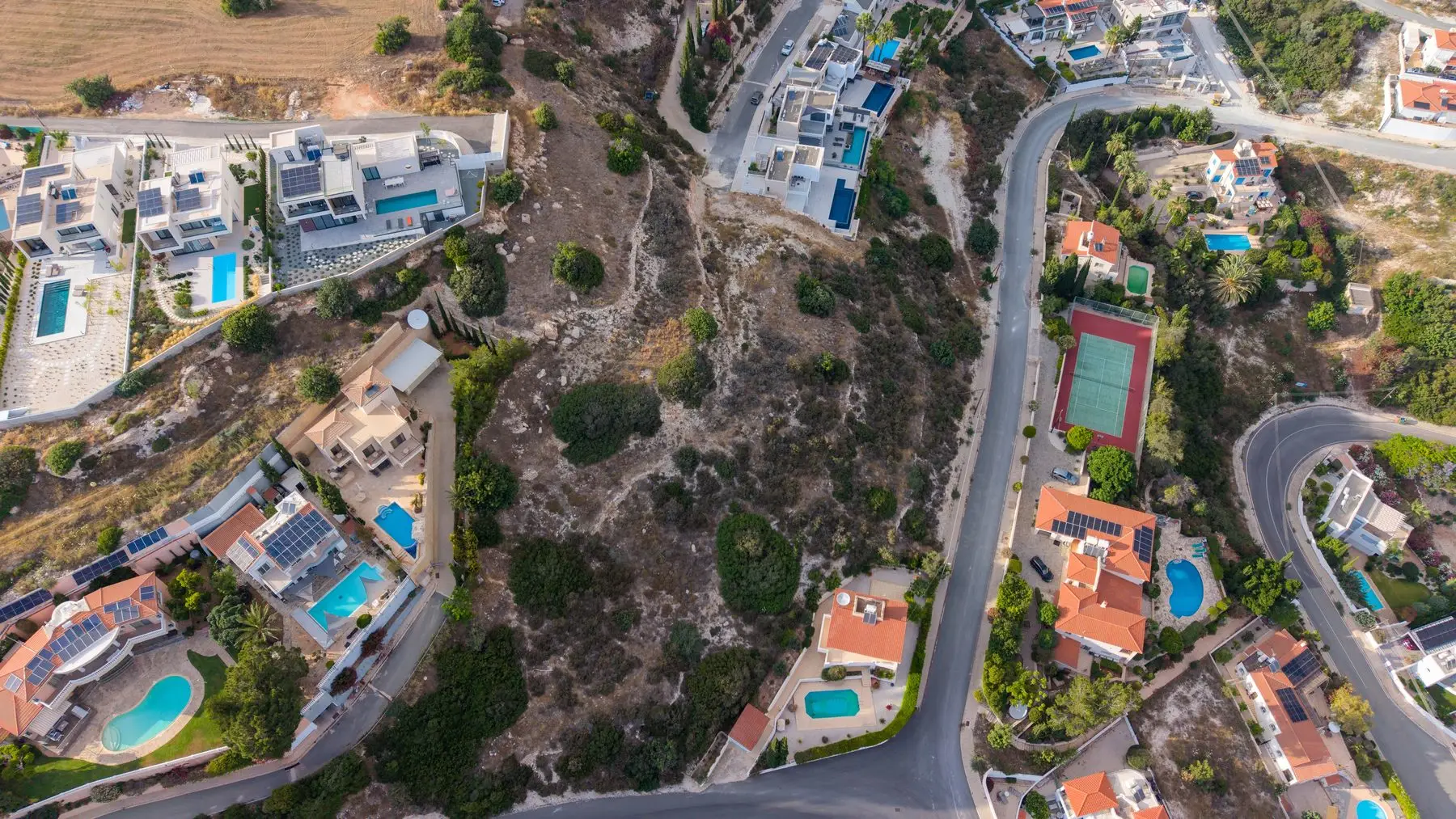
Paper due diligence will not catch most of that, because the paper is exactly what is out of date. This is where aerial due diligence earns its keep. In our experience the access road on the brochure is not always the access road on the ground — we have flown parcels where the tidy tarmac lane in the listing turned out to be a dirt track that stopped short of the boundary. A set of overhead photographs taken this week — not whenever the agent last visited — shows the plot as it actually is: its shape and terrain, what genuinely borders it, whether the access road is real, and what your future view actually contains. We cover this in detail on our land photography service page.
An overhead set answers the questions a listing never will: where the plot really ends, what borders it, and whether the access road exists.
One honest caveat: aerial imagery is indicative. It shows you reality, but it is not legal evidence of where your boundary sits — for that you need a licensed land surveyor, and any serious purchase should include one. The surveyor tells you where the lines are; the aerial set tells you what is inside and around them.
Problem 4: The north/south divide
This deserves a section of its own, stated plainly and neutrally. Since 1974, the island has been divided. In the north, a large share of the land is still legally claimed by Greek-Cypriot owners who were displaced during the division — and those claims have been recognised by the European Court of Human Rights. Under the law of the Republic of Cyprus, dealing in such property without the permission of its legal owner is a criminal offence, and cases have been pursued against foreign buyers.
That means a villa in the north can be genuinely cheap and genuinely dangerous at the same time: claims from the original owner, difficulty ever selling on, complications when crossing to the south or travelling in the EU, and — in any future political settlement — the possibility of restitution to the pre-1974 owner. The UK government's own guidance urges strong caution on exactly this point.
We are not telling anyone where to buy. We are saying that if you are considering the north, the title history of the specific plot is the single most important fact about it, and you need specialist, independent legal advice — not the seller's reassurance — before a single pound moves.
Problem 5: Buying from abroad, sight-unseen
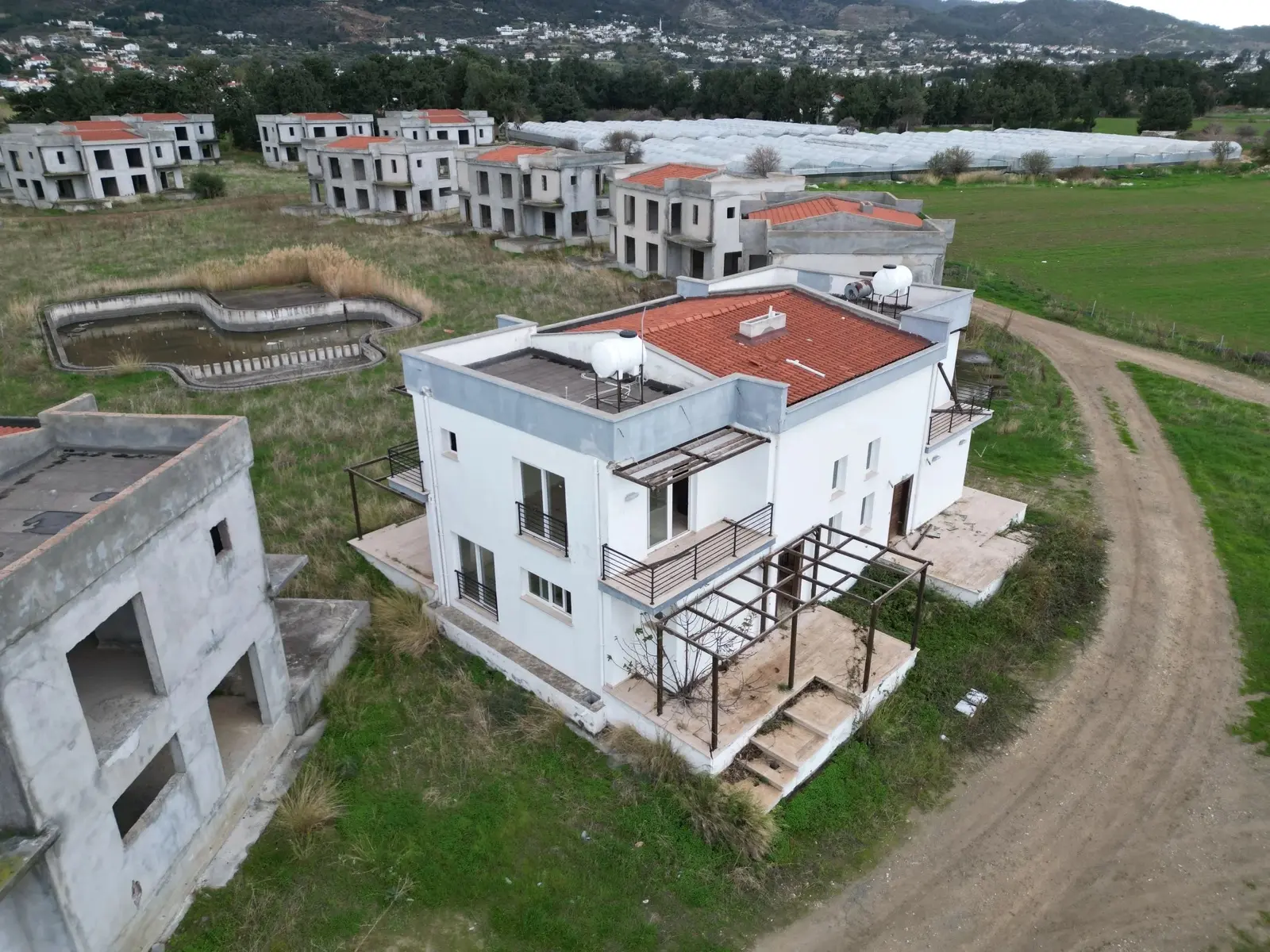
Every problem above gets worse when you are 3,000 kilometres away. Plenty of Cyprus purchases are agreed from the UK on the strength of a listing: a dozen sunny photos, a video walkthrough, a WhatsApp call with the agent. And listing photos are marketing — framed by the person who profits from the sale. They will not show the quarry over the ridge, the abandoned half-built shell next door, the plot's missing access road, or the fact that "sea view" requires standing on a ladder in one corner. We have flown plots for overseas buyers where the sunny photos hid exactly that kind of thing just outside the frame — a working quarry over the ridge line, a livestock yard next door — none of it visible until the drone climbed above the plot.
If the only photos you have seen were taken by the person selling it, you have not seen the property.
— our rule for remote buyers
The fix is independent eyes on the ground. Your own lawyer, chosen by you, is the first pair. Current aerial imagery is the second: a drone set commissioned by you, flown this week, showing the property and everything around it — unframed and uncropped. It is the closest thing to standing on the land yourself, and it costs less than a return flight to come and look.
The five problems at a glance
Problem
How to spot it
Who to hire
Title deed not transferable
Land Office check: does a separate deed exist in the seller's name?
Independent lawyer
Hidden mortgage or memo on the land
Land Search Certificate from the Department of Lands and Surveys
Independent lawyer
Boundary, access or planning surprises
Formal demarcation plus current overhead imagery of plot and surroundings
Licensed land surveyor + drone operator
Disputed title in the north
Full title history of the specific plot, pre- and post-1974
Specialist independent lawyer
Sight-unseen misrepresentation
Imagery and checks commissioned by you, not supplied by the seller
Lawyer + drone operator
A due-diligence checklist for buying in Cyprus
None of this is exotic. It is a short list of boring, inexpensive steps — and it defuses every problem in this article:
Hire an independent lawyer. Not the developer's lawyer, not the agent's recommendation — one who answers only to you. The single highest-value step on this list.
Run a Land Registry search. Confirm the seller actually owns the property, a title deed exists (or a clear path to one), and no mortgages, memos or other encumbrances sit on the land.
Verify planning status. Planning permission, building permits and — for completed buildings — the final approval certificate. For land, confirm the zoning and build coefficients support what you intend to build.
Engage a licensed land surveyor. Formal boundary demarcation so you know, legally, where the plot starts and ends.
Commission an aerial survey of the plot and its surroundings. Independent overhead photos of the land, its access and its neighbours — see our land photography packages.
Deposit the contract of sale at the Land Registry. This protects your right to the title through specific performance if the seller later fails to transfer.
Check the access road is registered. A track used by custom is not the same as a legal right of way. Your lawyer can confirm which one you are buying.
Never pay outside the contract. Reservation fees and deposits go through your lawyer, with terms in writing, refundable if due diligence fails.
The short version
An independent lawyer, a land search, a licensed surveyor and a current aerial survey together cost a few hundred euros. The problems they prevent are measured in tens or hundreds of thousands — and in years of court dates. That is the cheapest insurance you will ever buy.
— CyprusDroneX · Aerial land due-diligence
Buying a plot you can't visit?
We fly the plot and its surroundings so you see the real boundaries, access and context before you commit — across Cyprus, from €149.
This is the part we can help with directly. Before you commit to a plot or property anywhere on the island, we fly it and send you an independent overhead record of exactly what is there: the plot's true shape and terrain, the state and existence of the access road, and the context a listing will never volunteer — the neighbouring builds, the land use next door, the real view. The thing an aerial pass shows that even a ground visit can't is context at a glance — what sits over the next ridge, how the plot relates to everything around it, and whether the access lines up the way the plan claims. Standing at ground level, you simply cannot see it.
Our land photography starts at €149 for a Basic package (10 overhead photos) or €249 for the Standard package (20 photos plus a 60–90 second video flyover that lets you "walk" the plot from your sofa). If you want measurements, the orthomosaic add-on (+€299) stitches the flight into a to-scale, measurable map of the plot — we explain how that works in our plain-English guide to orthomosaic maps. We serve the Republic of Cyprus and deliver within 48–72 hours, which usually means you have the imagery before your next call with the agent.
To be clear about what this is and is not: our imagery and orthomosaics are indicative — superb for spotting problems, judging access and understanding context, but not a legal boundary survey. For the legal lines, hire a licensed land surveyor; for everything the paper cannot show you, fly the plot. And if you go on to buy and build, the same approach keeps working — see our guide to monitoring a Cyprus construction project from abroad.
Against a six-figure purchase, €149–€548 of aerial due diligence is not really a cost at all — it is the difference between buying what you were shown and buying what is there. Send us the plot location and we will confirm coverage and timing the same day.
Frequently asked questions
What are the pitfalls in buying property in Cyprus?
The recurring ones: title deeds stuck in the developer's name, mortgages and memos hidden on the land, boundary and planning surprises (including access roads that exist only on paper), disputed ownership in the north, and buying sight-unseen from seller-supplied photos. Each is avoidable with an independent lawyer, a land search, a licensed surveyor and current aerial imagery — before you sign.
Is it wise to buy property in Cyprus?
Yes, if you treat it as a serious legal transaction. The Republic is an EU jurisdiction with a functioning Land Registry, and most purchases complete without trouble. The buyers who end up in the horror stories are overwhelmingly the ones who used the seller's lawyer, skipped the land search, or never independently verified the property before paying.
What is the no-go zone in Cyprus?
People usually mean the UN-controlled buffer zone — the Green Line that separates the Republic from the Turkish-occupied north — and the fenced district of Varosha in Famagusta. Property in the buffer zone cannot be freely accessed or developed. More broadly, buying in the north carries serious legal risk because much of the land there is still legally claimed by displaced Greek-Cypriot owners.
Can I buy property in Cyprus as a UK citizen after Brexit?
Yes. Non-EU nationals can buy in the Republic of Cyprus, though you will generally need District Office permission — normally a formality for a single home or plot. Two things to plan around: ownership does not grant residence rights, and the 90-days-in-180 rule limits how long you can stay without a visa or residence permit.
Should I get a survey before buying land in Cyprus?
Yes — ideally two. A licensed land surveyor establishes the legal boundaries and can formally demarcate the plot. An independent aerial survey shows its real condition and context: terrain, access, neighbouring land use and anything the listing left out. Together they cost a few hundred euros against a six-figure purchase.
How much does an aerial survey of a Cyprus plot cost?
Our packages start at €149 (Basic: 10 overhead photos) and €249 (Standard: 20 photos plus a 60–90 second flyover). A measurable orthomosaic map is a +€299 add-on. We fly anywhere on the island and deliver within 48–72 hours — details on the land photography page.
This article is general information, not legal advice. Property law in Cyprus is a specialist field and every purchase is different — always instruct an independent lawyer and a licensed land surveyor before committing to a purchase.
From photo sets to orthomosaics — which survey fits which job.
Eyeing a plot in Cyprus?
Before you sign, let us fly it. We've done exactly this for buyers up and down the island — independent overhead photos of the plot, its access and its neighbours, delivered within 48–72 hours from €149. Send us the location and we'll confirm coverage the same day.